
Our lab works at the interface of chemistry, biology and engineering to design and engineer proteins to manipulate cell architecture, seeking to understand intracellular transport and design new protein machines for engineering biology.
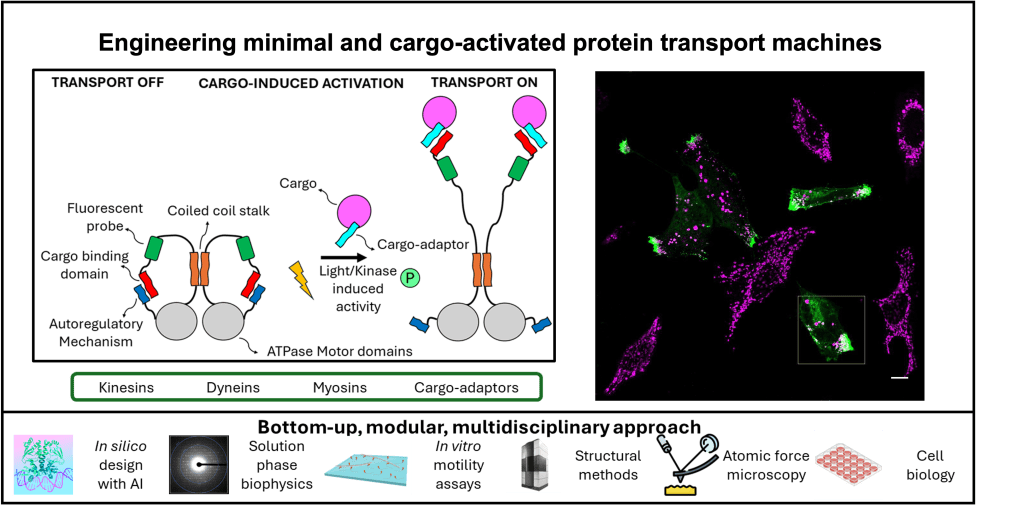
Engineering minimal and cargo-activated protein transport machines
Molecular motors are essential for life and efficiently transduce chemical energy to mechanical work. Our research aims to elucidate the requirements for motility and energy transduction in motor proteins. To do this, we are working to engineer a synthetic motor from the bottom up. This will help us to understand the minimal components needed for regulation and motility and generate new engineered machines for applications in drug-delivery and building synthetic cells.
Protein design and engineering to control cell architecture
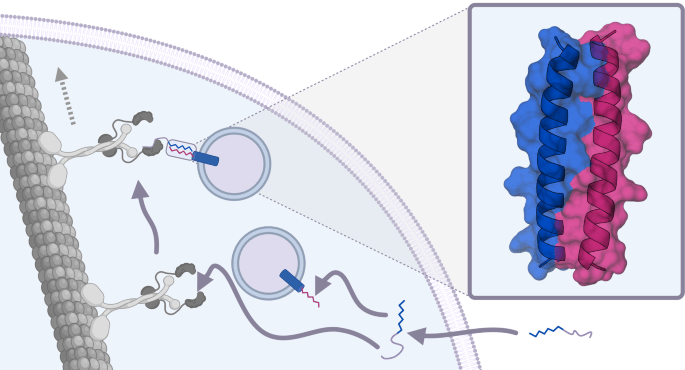
Our research combines synthetic and cell biology to uncover the fundamental mechanisms of cytoskeletal motors inside cells. Our work has delivered mechanistic understanding of autoinhibition of kinesin-1 motors and has delivered a synthetic peptide toolkit to manipulate kinesin cargo recognition through synthetic cargo-adaptors, and activation through an inducible conformational switch in the regulatory mechanism. We can confer cell-penetrating properties to these peptides to allow their use in cells. We are now working to deliver new synthetic tools to allow us to understand and hijack proteins throughout transport and trafficking networks.
 Jess Cross Lab